Iconic Film Character Intros: Tangina's 'Poltergeist' Entrance Is Instantly Iconic
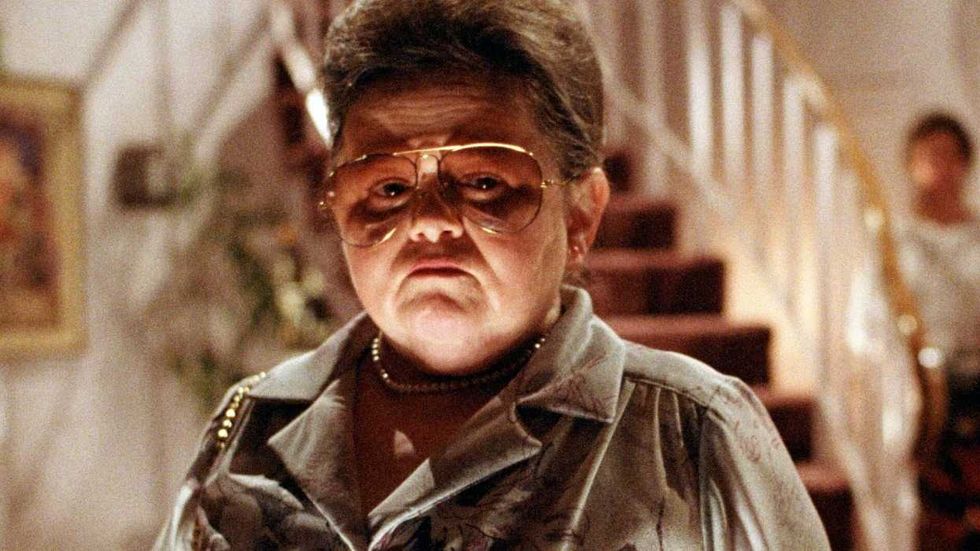
The way Tobe Hooper’s 1982 horror classic Poltergeist introduces eccentric spiritual medium Tangina Barrons (Zelda Rubinstein) is instantly unforgettable. At that time, it seemed like nothing could even come close to beating the iconic arrival of Father Lankester Merrin (Max von Sydow) in 1973’s The Exorcist , which is such a striking image that it made the poster for the movie. However, Poltergei

The way Tobe Hooper’s 1982 horror classic Poltergeist introduces eccentric spiritual medium Tangina Barrons (Zelda Rubinstein) is instantly unforgettable. At that time, it seemed like nothing could even come close to beating the iconic arrival of Father Lankester Merrin (Max von Sydow) in 1973’s The Exorcist, which is such a striking image that it made the poster for the movie. However, Poltergeist proved that there were still more avenues to explore in the horror genre thanks to exquisite work from a team of incredible artists.
Tangina’s Entrance Comes at the Perfect Time in Poltergeist
Poltergeist is extraordinarily patient when it comes to introducing its most memorable character. More than two-thirds of the movie has already passed by the time Tangina makes her first appearance, but that time (which amounts to more than an hour) is well-spent, setting the stage for her arrival.
After spending some time introducing the seemingly bucolic suburban neighborhood in which the haunted house movie takes place, the conflict springs into action when young Carol Anne Freeling (Heather O'Rourke) is spirited away through the television. As she remains lost in a ghostly realm, her parents - Diane (JoBeth Williams) and Steve (Craig T. Nelson) - grow increasingly desperate.
It is quite clear that something supernatural is going on in the house, so despite their doubts, they seek out Dr. Lesh (Beatrice Straight), a parapsychologist who has an office and a team that uses modern equipment to track spiritual phenomena. Her completely mundane approach to the supernatural is designed to show that, while the Freelings are stepping out of the realm of the natural and normal, they’re just dipping their toes into the water of the supernatural. Dr. Lesh is a “safe” woman whose work involves unusual things, but who presents herself and that work in a way that is digestible for the average materialist suburbanite.
However, as the Freelings grow increasingly desperate throughout the movie, they (or at least Diane) are more willing to delve further into the world of the spiritual. Enter Tangina.
Poltergeist is just as patient when it comes to pacing the scene where Tangina is introduced. Dr. Lesh and the Freelings are seen and heard talking to her via the perspective of a cameraman in the living room as she is given a tour of the house, but she doesn’t appear or speak until they enter the living room, more than 20 seconds into the scene.
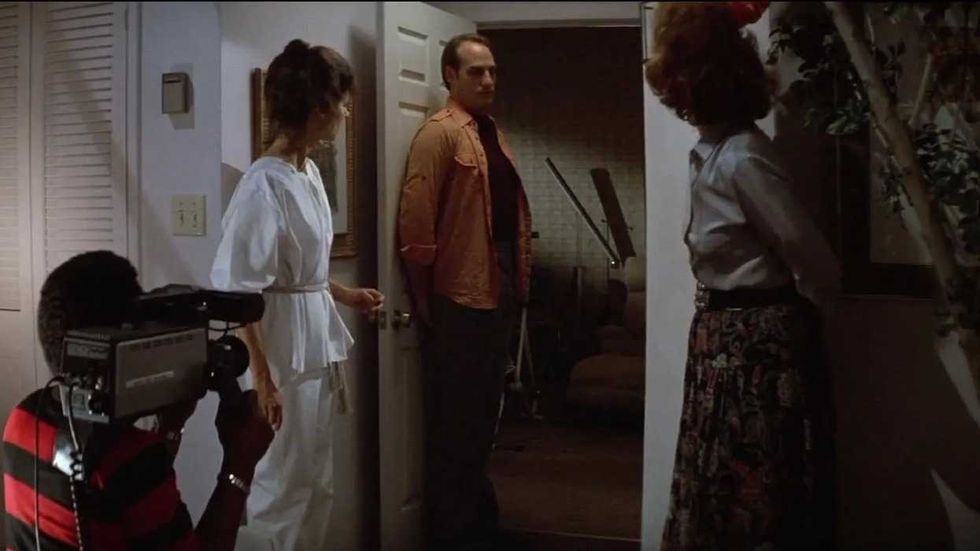 ‘Poltergeist’ (1982)Credit: MGM/UA Entertainment Co.
Tangina’s diminutive stature and high-pitched Southern drawl are instantly arresting. This is a woman who eschews everything about the vanilla presentation of the suburban home around her, and this slow build toward the ultimate reveal emphasizes how unusual she seems in this context.
Also, like many of the best character entrances in cinema history, the mise-en-scène in this moment mimics a theatrical curtain opening. The doorway through which the characters are walking focuses the eye and the figures in the foreground part, allowing Tangina to step out and take center stage.
Poltergeist Introducing Tangina in a One-Shot Underscores the Scene’s Importance
Another tremendously effective technique used in Tangina’s introduction is the fact that the majority of the scene is a one-shot. The long single take highlights Tangina’s importance in two ways. First, it tracks her every movement, winding through her house just as she does. The sinuous movement of the camera feels confident and powerful, just like Tangina does. She steps into the space like she owns it. This is emphasized by the way Rubinstein performs Tangina’s ascent up the staircase, walking straight toward it without asking for permission, racing up the stairs by the end as she picks up the scent of something. She is not concerned with the mundane laws of propriety, but rather with the rhythms of the house and the most effective way to do her work.
Second, except for the moment where she first steps into frame so the camera can bask in her glory, the blocking tends to keep her at arm’s length, farther away from the camera than other objects or characters. This is effective for a multitude of reasons, first and foremost because she is meant to be unknowable and mysterious. Therefore, it is only infrequently that we, the audience, are allowed to get a good look at her.
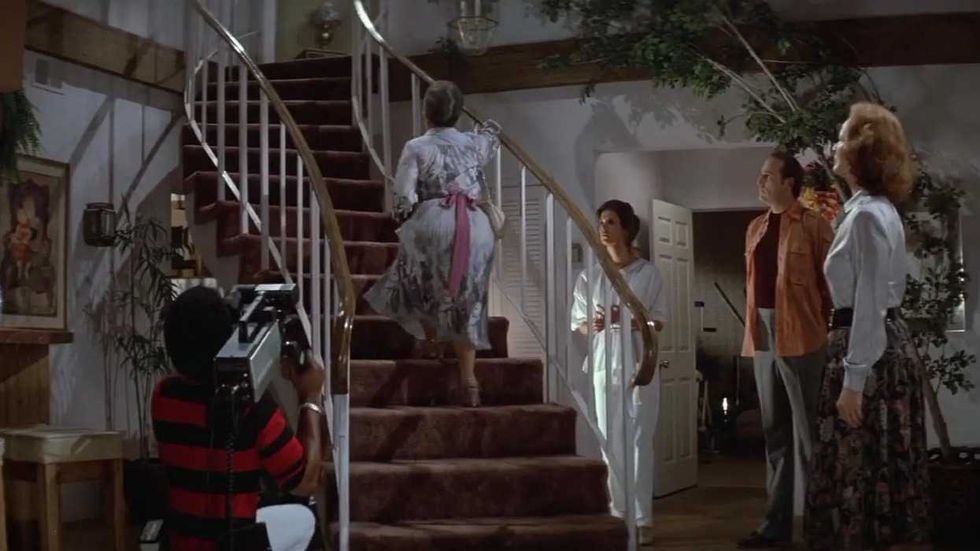 ‘Poltergeist’ (1982)Credit: MGM/UA Entertainment Co.
In doing this, Poltergeist allows us to get an even stronger sense of Tangina’s impact on the world around her by leading with the way the other people in the scene react to her. While Dr. Lesh, Diane, and the cameraman stand in awe of her aura, Steve is less convinced. However, after cracking a joke about how kooky things have gotten, he too is awed by her when she re-emerges from upstairs, forcing herself back into the scene by addressing Steve with what is, to him, a surprisingly direct question about a locked door in his house.
By taking charge of the house, Tangina also takes charge of the camera. The scene moves entirely at her rhythm, nobody else’s, and that applies to both the cinematography and the editing. Case in point, when the one-shot ends, it does so in order to deliver her second close-up, when she asks Steve about the door.
While Tangina’s quiet, calm power is largely depicted visually in the scene, it is also delivered through dialogue. In addition to the aforementioned conversation between her and Steve, this comes through in the quiet, almost sardonic way she shuts down Dr. Lesh when the doctor informs her about the heart of the house. She corrects Dr. Lesh with a tossed-off “this house has many hearts” before wandering away again.
This line, while simultaneously funny, warm, and offbeat, also manages to instill hope that Carol Ann can be recovered. The fact that Tangina clearly knows so much more about the situation than Dr. Lesh indicates both to the Freelings and to the audience that she is the right person to turn to. It’s not easy to accomplish all of that at once, but Poltergeist does. In one beautifully captured two and a half minute scene, Tangina waltzes into the movie, turns it on its axis, and kicks the third act into gear. Now that’s cinema!
For more on the Tobe Hooper movie, check out the archives of No Film School, which include articles on the myth that Steven Spielberg secretly directed Poltergeist, its place among the scariest movies ever, and the ways it influenced James Wan’s Insidious.