The Halloween Specials That Defined Everyone's Childhood October
The end-of-year months are the best. We start getting into the holiday spirit, cooler weather, and awards season. It's the most wonderful time of the year. With Halloween coming up, a lot of us are probably watching our favorite scary movies and TV shows. Those might include some Halloween specials. Before streaming, these specials were appointments. You checked the TV listings, made sure you were
The end-of-year months are the best. We start getting into the holiday spirit, cooler weather, and awards season. It's the most wonderful time of the year. With Halloween coming up, a lot of us are probably watching our favorite scary movies and TV shows. Those might include some Halloween specials.
Before streaming, these specials were appointments. You checked the TV listings, made sure you were home, and maybe ate some of your candy early. Everyone's October had a lineup, and which specials were on it depends on when you grew up.
This list covers six of them, from 1966 to 2014, so everyone's childhood should be included somehow. Each one shows how to make seasonal work that people want to come back to every year.
Let's dive in!
It's the Great Pumpkin, Charlie Brown
Peanuts! In this one, Linus is in the pumpkin patch, waiting all night for something that never shows up. It's a strange premise for a kids' special, because it's a holiday story that ends in disappointment.
Peanuts had already made a hit Christmas special the year before. Charles Schulz, Bill Melendez, and Lee Mendelson were told, "We need you to come up with a blockbuster like Christmas" (via HuffPost).
"I think that the Great Pumpkin was one of the best of the 50 specials we did," said Mendelson. "The foundation for the story came right out of the comic strip, one of Schulz's most famous themes about Linus in the pumpkin patch."
They used Christmas as a jumping-off point, the team said.
"The comedic theme was Linus apparently getting his holidays mixed up and confusing the Great Pumpkin with Santa Claus," Mendelson said. "But the larger theme was that we don't always get what we want. He [Schulz] was thinking of poor children who might receive nothing or next to nothing and that it was something you had to endure and hope for better times. Trying to take something serious and make it less serious by making it funny."
Their budget was somewhere between $100,000 and $150,000. Their plot was simple, but they created beautiful images and a new holiday classic to go with it. This year is the special's 60th anniversary.
The Simpsons and "Treehouse of Horror"
Once a year, the most popular family on TV dropped the show's continuity and did a horror anthology, starting in 1990.
The "Treehouse of Horror" traces its the tradition back to Season 2, the show's first full season. The first one hit TV on October 25, 1990. The idea had to fight its way through the writers' room.
Writer Jay Kogen told Yahoo Entertainment that it was Matt Groening's idea, but the staff didn't immediately embrace it.
"It was Matt's baby," Kogen said. "It took a while for the idea to ferment with the writers; eventually our showrunner, Sam Simon, said, 'That's a great idea, let's do it.'"
According to Little White Lies, Simon had a collection of EC Comics in his office, the publisher behind the Tales from the Crypt and Weird Science anthologies.
"The idea was to do something that emulated those comics," said animator David Silverman (via Little White Lies). "Kang and Kodos, the slobbering aliens in the second segment of the first Halloween special, were ripped straight off one of the covers."
The first episode's prestige segment was a Poe adaptation, and Fangoria said that Groening worried it was too pretentious. But now the yearly special is always among the most popular episodes.
Halloweentown
In 1998, a young character learns she's really a witch. For a generation of Disney Channel kids, this was October.
When Halloweentown premiered on October 17, 1998, it was the fourth Disney Channel Original Movie. Debbie Reynolds (yes, that Debbie Reynolds) was the first actor cast.
Before Disney Channel picked it up, the project lived at NBC, and the original script had a much grimmer ending in store for Marnie.
"I wrote the script," Paul Bernbaum told Bustle. "In fact, Marnie, Dylan, and Sophie are my kids' names. NBC decided to pass on it. Cut to five years later, and I get a call from Steve saying, 'Hey, we're doing Halloweentown, we're going to shoot it.' I was stunned, because that really never happens."
Then the money shrank. Director Duwayne Dunham said that it was pitched to him as a $20 million to $30 million project, but the budget ended up being $4 million (via ScreenRant). But with a story full of heart and whimsy, it found its audience.
"Disney had presented me the script, and I read it, and I thought, 'Holy smokes, this is big, I mean really big.' They said, 'Yeah, we know, we just have to cut it down,'" Dunham told MTV News.
A decade later, network sitcoms raised the stakes for the Halloween episode.
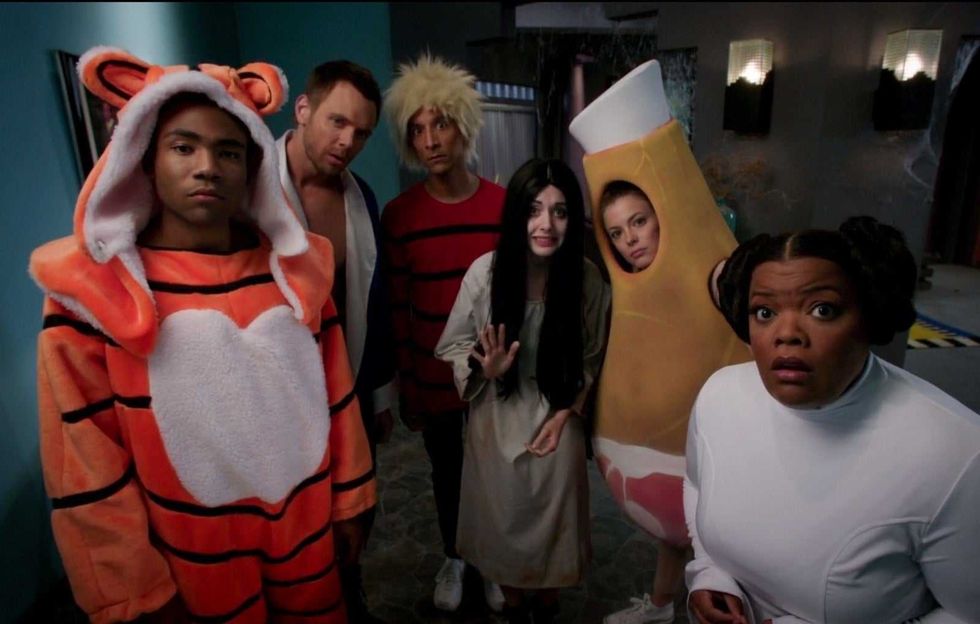
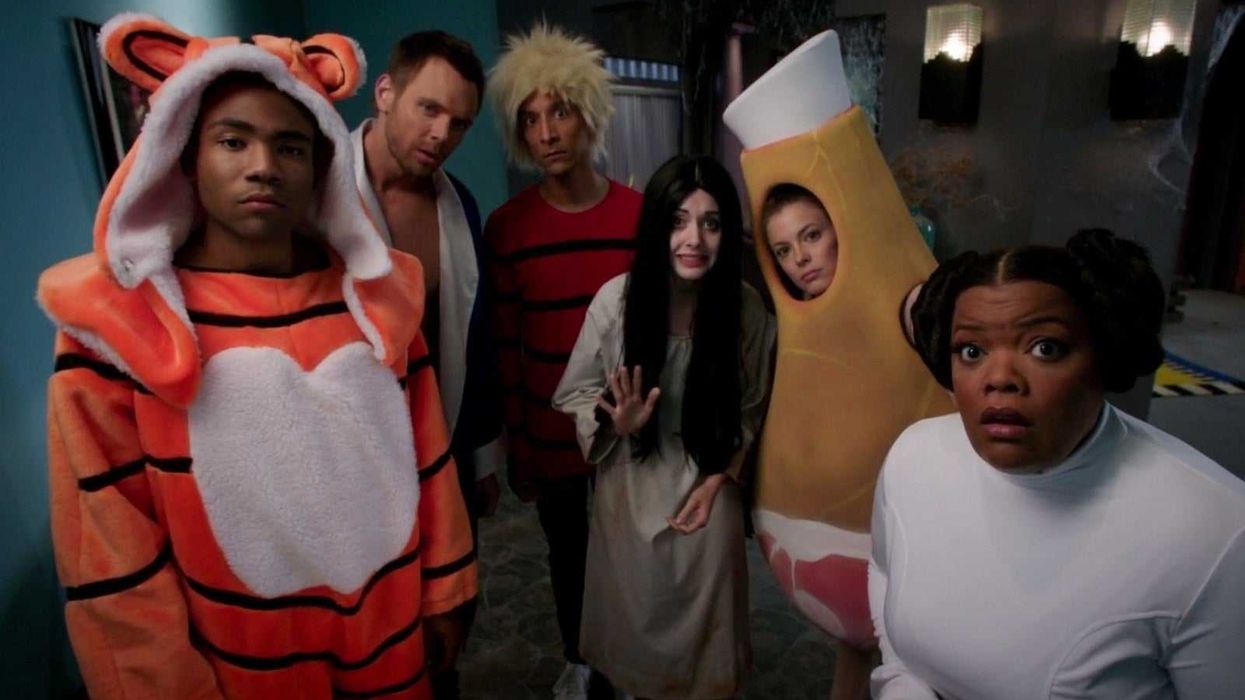
Community and "Epidemiology"
This was a sitcom that showed how to handle genre, with Dan Harmon at the helm. Imagine it—zombies tearing through a community college Halloween party, scored entirely to ABBA.
The episode premiered on NBC on October 28, 2010, as a Halloween episode, written by Karey Dornetto and directed by Anthony Hemingway, with George Takei narrating. Den of Geek notes it premiered three days before The Walking Dead. The Houston Press gave the writers credit for turning the undead into a semi-plausible disease, and gave a shout-out to the episode's spooky remix of the opening credits.
In his episode-by-episode walkthrough with The A.V. Club, Harmon said the room kept pitching explanations for zombies at Greendale until it ran out of ideas.
It wasn't easy. According to Harmon:
We broke that story, and it was like dog paddling through mud, and it just felt like cleverness for the sake of cleverness. The story just kept being dead weight, like a child that doesn't want to leave a party and goes limp. We can move it because we’re bigger than it, but there’s something wrong. And there was a point where I said, “What is our nightmare? What is the biggest sin that we're not supposed to be committing here? What started us down the road of thinking of ways to do a zombie movie without doing a zombie movie? What happens in our zombie movie that can’t happen in our sitcom?” Easy answer: People die. Okay, absolutely right. But how much of the zombie motif has to do with people dying? Well, a lot. It's about diminishing numbers, but the reason numbers diminish is because when you die you become a zombie. What if you became a zombie just by being bitten? And it went down this road very quickly. And that was late in the game. If we hadn’t spent a month doing stupid Prozac metaphors, God only knows what could have happened with that episode.
A genre episode has to obey your show's own logic. Justify the monster inside your world, then go big.
Toy Story of Terror!
Sometimes putting your happy-go-lucky characters in a scary setting is enough. Such is the case with Toy Story of Terror.
D23 names it as the first short Pixar ever made for television. Going full Halloween gave the team an excuse to sneak in nods to horror favorites like The Shining, Predator, and The Silence of the Lambs. For example, the motel key was inspired by the one from the Overlook Hotel, and Combat Carl, voiced by Predator's Carl Weathers, gets an introduction that directly references a line from that film.
"One of the most satisfying format differences was having the ability to end on a downbeat," director Angus MacLane told D23. "We had to figure out how to put the characters in bad situations right before the commercial break. And each gets progressively worse. So we kept trying to outdo each one."
Act breaks are cliffhangers, which are necessary in TV to keep the audience hooked. "Under all the horror gags, MacLane built the special around Jessie. Getting trapped and shut away hits her harder than the other toys because being left behind is her oldest fears.
Over the Garden Wall
The animated show opens on two brothers lost in the Unknown, a forest of pumpkin people, talking animals, and something stalking them called the Beast. While not technically a Halloween special, the series is 10 short episodes that fans now rewatch every fall. There is plenty of spooky material to make it seasonally appropriate.
Showrunner Patrick McHale pitched it to Cartoon Network in 2006, and originally envisioned 18 chapters. He told Inverse that the final season of Breaking Bad was an influence.
"It's hard to even start listing all the things I learned on Adventure Time," he told Inverse. "I guess the most important thing I got from AT was confidence. I'd learned all the important ins-and-outs of running a show, so although Over the Garden Wall was quite a difficult show to make, the production was actually pretty smooth sailing."
What's your favorite Halloween special?